

Mirrors guide the laser beam through a CO₂ laser machine. Their quality affects laser power, cutting accuracy, engraving quality, and system reliability. CO₂ lasers usually operate at a wavelength of about 10.6 µm, so their mirrors require suitable infrared materials and coatings.
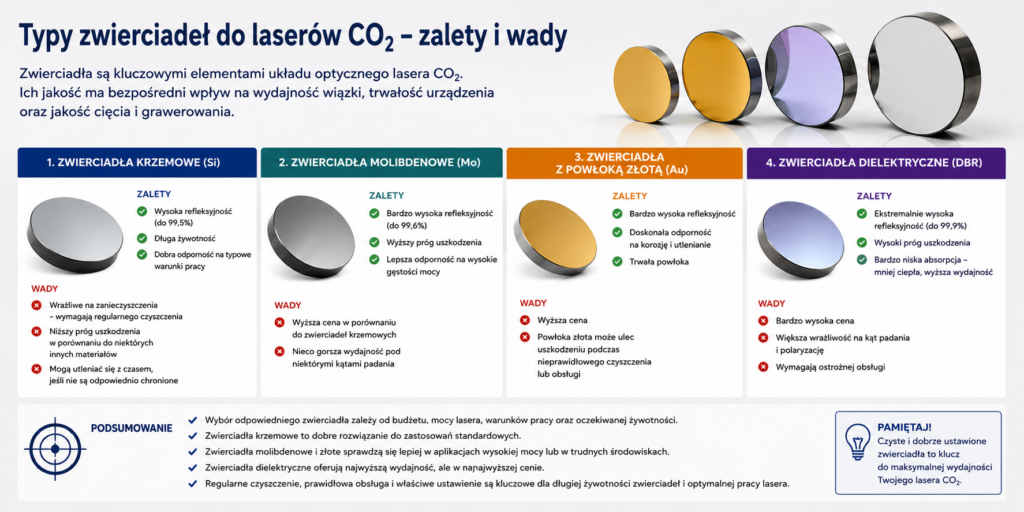
Silicon Mirrors
Silicon mirrors are common in small and medium-power laser machines.
Advantages:
They are lightweight, affordable, widely available, and suitable for standard cutting and engraving.
Disadvantages:
Silicon is brittle and has lower thermal conductivity than copper. Its reflective coating can also be damaged by dirt or improper cleaning.
Molybdenum Mirrors
Molybdenum mirrors are designed for demanding working conditions.
Advantages:
They are durable, scratch-resistant, and suitable for environments with smoke, dust, and frequent cleaning.
Disadvantages:
They are more expensive and may reflect slightly less laser energy than high-quality gold or dielectric mirrors.
Copper Mirrors
Copper mirrors are often used in high-power industrial lasers.
Advantages:
Copper conducts heat very well, reduces overheating, and can be water-cooled.
Disadvantages:
It is heavier than silicon, can oxidize, and usually needs a protective coating.
Gold-Coated Mirrors
Gold coatings are commonly applied to silicon or copper substrates.
Advantages:
They provide high infrared reflectivity, low energy absorption, and good corrosion resistance.
Disadvantages:
Gold is soft and can be scratched easily. Gold-coated mirrors also require careful cleaning and handling.
Dielectric Mirrors
Dielectric mirrors use several thin optical layers to achieve very high reflectivity.
Advantages:
They offer excellent efficiency, low absorption, and minimal power loss.
Disadvantages:
They are expensive and sensitive to wavelength, beam angle, and polarization.
Conclusion
Silicon mirrors are a practical choice for standard machines. Molybdenum is best for durability, copper for high-power systems, gold coatings for corrosion resistance, and dielectric mirrors for maximum efficiency.
Regular cleaning, correct alignment, and careful handling help maintain laser performance and extend mirror life.
Mój laser o mocy 100 W ze sterownikiem Ruida jest wyposażony w lustra molibdenowe. Pracują one już od 1500 godzin i sprawdzają się znakomicie.