


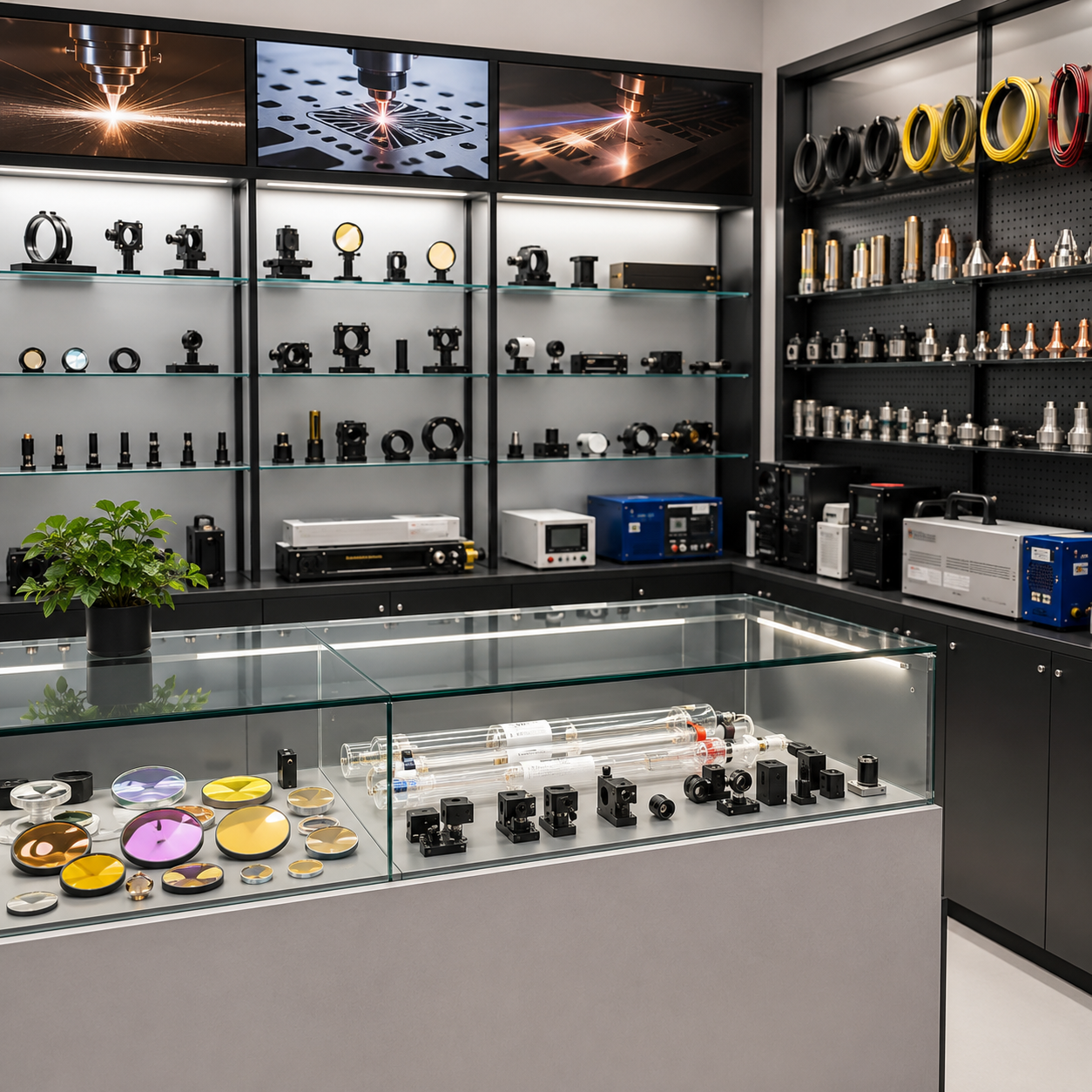
CO₂ laser tubes have been the core component of most laser cutting and engraving machines for many years. Despite the rapid development of fiber lasers, CO₂ technology remains one of the best choices for processing wood, acrylic, leather, fabric, and many other non-metallic materials.
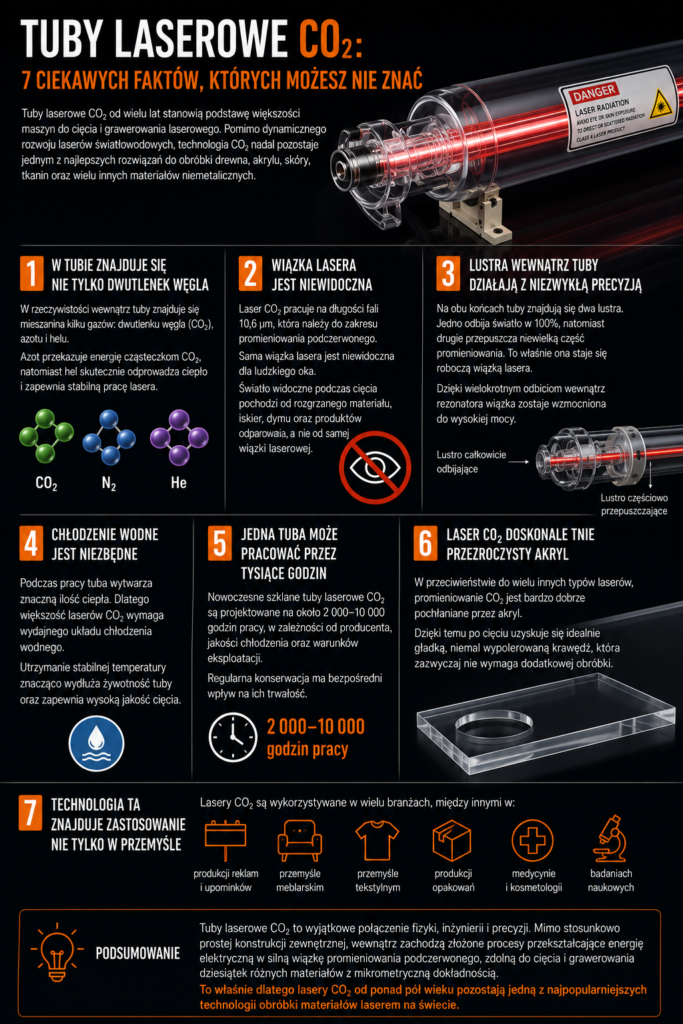
1. The Tube Contains More Than Just Carbon Dioxide
The name “CO₂ laser” can be slightly misleading. In reality, the tube contains a mixture of several gases: carbon dioxide (CO₂), nitrogen, and helium.
Each gas has a specific role. Nitrogen transfers energy to the CO₂ molecules, while helium helps dissipate heat efficiently and maintain stable laser operation.
2. The Laser Beam Is Invisible
A CO₂ laser operates at a wavelength of 10.6 micrometers, which lies within the infrared spectrum. This means that the laser beam itself cannot be seen by the human eye.
The visible glow during cutting comes from heated material, sparks, smoke, and vaporized particles—not from the laser beam itself.
3. The Mirrors Inside the Tube Work with Exceptional Precision
There are two mirrors positioned at the ends of the laser tube. One mirror reflects the light completely, while the other allows a small portion of the radiation to pass through. This emitted radiation becomes the working laser beam.
As the light reflects repeatedly inside the resonator, it is amplified until it reaches a high power level.
4. Water Cooling Is Essential
The tube generates a significant amount of heat during operation. That is why most CO₂ lasers require a water-cooling system.
Maintaining a stable temperature greatly extends the tube’s service life and helps preserve consistent cutting quality.
5. One Tube Can Operate for Thousands of Hours
Modern glass CO₂ laser tubes are typically designed to operate for approximately 2,000 to 10,000 hours, depending on the manufacturer, cooling quality, and operating conditions.
Proper maintenance has a direct impact on the tube’s lifespan.
6. CO₂ Lasers Cut Clear Acrylic Extremely Well
Unlike many other types of lasers, CO₂ laser radiation is absorbed very effectively by acrylic.
As a result, the cutting process produces a smooth, almost polished edge that often requires no additional finishing.
7. This Technology Is Used Far Beyond Industrial Manufacturing
CO₂ lasers are used in a wide range of industries and applications, including:
- advertising and souvenir production;
- furniture manufacturing;
- the textile industry;
- packaging production;
- medicine and cosmetology;
- scientific research.
Conclusion
CO₂ laser tubes are a remarkable combination of physics, engineering, and precision. Despite their relatively simple external design, complex processes take place inside the tube, converting electrical energy into a powerful infrared beam capable of cutting and engraving dozens of different materials with extremely high accuracy.
That is why CO₂ lasers have remained one of the most widely used technologies in laser material processing for more than half a century.
WoW Super, świetne informacje.